Is It Too Late to Plant? The Fall Planting Countdown
It’s mid-October and you have an empty bed. Can you still sow something and actually eat it? It depends on where you are and what you plant.
TL;DR:
- Cold-fall places like Chicago and Denver: the first hard freeze usually comes by early November (Chicago) or mid-October (Denver). Crops from seed are very unlikely to reach full size. Plant garlic, or use transplants under cover.
- Late-frost places like Seattle, Dallas and Atlanta: your best bets are fast, hardy crops like turnip greens. Even quick semi-hardy crops such as radishes are roughly a coin flip, and need a cover for the first frosty nights.
- Frost-tender crops (beans, squash, cucumbers, tomatoes): too late almost everywhere. We checked all 6,199 lower-48 stations in our data where it freezes every year. At every one, the median first 32°F night comes before December 31, which is when bush beans sown today would be ready. The only exceptions are stations where it doesn’t freeze every year, mostly in California, Florida, Texas, Arizona and Louisiana.
Falls are also getting longer in many places. Climate Central’s 2025 analysis of NOAA data found that the first fall freeze now arrives later in 179 of 204 U.S. cities (88%) than in the early 1970s, by 12 days on average. Our odds use NOAA’s 1991-2020 normals, so they describe that 30-year period, not any single recent fall.
Here’s how to work it out for your own ZIP code.
How the fall planting countdown works
The extension formula
Extension services use the same simple formula to plan fall crops. The University of Nebraska-Lincoln (UNL), Virginia Cooperative Extension and University of Maryland Extension all publish versions of it. UNL’s version adds up:
- Days to maturity (from seeding or transplanting outdoors to harvest)
- Days to grow transplants, if you start your own
- Average harvest period
- Fall factor: about 14 days
- Frost-tender factor: 14 more days, only for frost-sensitive crops
- Total: days to count back from the first expected fall frost
The fall factor is there because seed-packet days to maturity assume summer conditions. In fall, shorter days and cooler weather slow growth. UNL and Virginia Tech both put it at about two weeks. The frost-tender factor applies to crops like corn, beans, cucumbers, tomatoes and squash. In UNL’s words, “These plants must mature at least two weeks before frost in order to produce a reasonable harvest.”
Our examples leave out two terms, the harvest period and transplant time. Sources don’t give a single harvest-period figure we could apply to every crop, and it depends on how long you want to keep picking. So the “ready” dates below are when harvest can start. If you want three weeks of picking, add three weeks to the ready date, or plant three weeks earlier.
Which frost counts for each crop
Most guides compare the total with your “average first frost date.” We check it against your odds of frost by that date instead, using NOAA’s 1991-2020 data for your nearest station. Which frost counts depends on the crop:
- Tender crops: the first 32°F night. They can’t take any frost.
- Semi-hardy crops: also the first 32°F night. UNL lists semi-hardy vegetables as standing light frost of 30 to 32°F. NOAA publishes frost dates at 16, 20, 24, 28, 32 and 36°F, with no 30°F level. The 28°F “hard freeze” is colder than the 30°F limit UNL gives, so using it would overstate how long these crops last. That leaves 32°F, the closest NOAA threshold within UNL’s range. It’s on the cautious side. A radish that handles 30°F will often survive a little past the first 32°F night.
- Hardy crops: the first 28°F night, the National Weather Service’s “hard freeze.” UNL says hardy vegetables stand several frosts and are killed when temperatures drop near 20°F. Our lookup carries NOAA’s 28°F, 32°F and 36°F dates (not 20°F), so we use 28°F. That’s a cautious cutoff for hardy crops, and they’ll often go longer.
These cutoffs are our reading of UNL’s temperature ranges, not an extension recommendation.
Can you still plant now? Worked examples for October 14
Ready dates for seven fast crops
Days to maturity below are the short end of the ranges in University of Missouri Extension’s planting guide (G6201). Pick the fastest varieties for late sowing, and check your own seed packet. Ready dates assume sowing on October 14, this article’s publication date. If you’re sowing later, add the extra days to each date. The odds only get worse.
| Crop | Days to maturity (MU range) | Frost group | + factors | Harvest can start about |
|---|---|---|---|---|
| Radish | 25-35 | Semi-hardy | +14 | Nov 22 |
| Mustard greens | 30-40 | Semi-hardy | +14 | Nov 27 |
| Leaf lettuce | 35-50 | Semi-hardy | +14 | Dec 2 |
| Turnip greens | 35-45 | Hardy | +14 | Dec 2 |
| Spinach | 40-50 | Semi-hardy | +14 | Dec 7 |
| Kale | 50-65 | Hardy | +14 | Dec 17 |
| Bush snap beans | 50-60 | Tender | +14 +14 | Dec 31 |
Frost groups follow UNL’s table. Turnip greens use UNL’s listing for turnips.
Your odds of beating the frost
This table shows the estimated chance that the crop’s limiting frost comes before harvest can start. That’s 32°F for semi-hardy and tender crops and 28°F for hardy ones. Lower is better.
| Station (NOAA ID) | Radish | Mustard | Leaf lettuce | Turnip greens† | Spinach | Kale† | Bush beans |
|---|---|---|---|---|---|---|---|
| Seattle-Tacoma Intl AP, WA (USW00024233) | 48% | 58% | 70% | 32% | 80% | 59% | >90% |
| Dallas-Fort Worth AP, TX (USW00003927) | 46% | 58% | 70% | 38% | 83% | 72% | >90% |
| Atlanta Hartsfield Intl AP, GA (USW00013874) | 57% | 68% | 80% | 42% | 86% | 70% | >90% |
| Memphis Intl AP, TN (USW00013893) | 68% | 80% | 88% | 62% | >90% | 89% | >90% |
| Raleigh-Durham Intl AP, NC (USW00013722) | >90% | >90% | >90% | 84% | >90% | >90% | >90% |
| Chicago O’Hare Intl AP, IL (USW00094846) | >90% | >90% | >90% | >90% | >90% | >90% | >90% |
| Denver Intl AP, CO (USW00003017) | >90% | >90% | >90% | >90% | >90% | >90% | >90% |
†Hardy crops, checked against 28°F. All other columns use 32°F.
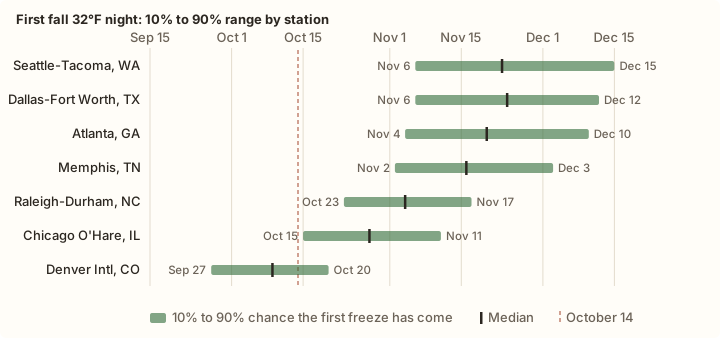
How these odds are calculated:
- Interpolated. We draw a straight line between NOAA’s published 10% to 90% dates. “>90%” means harvest would start after NOAA’s 90% date, so we don’t estimate further.
- Adjusted where a hard freeze isn’t certain. Seattle-Tacoma reaches 28°F in 94.7% of years, and Atlanta in 99.8%. At stations like these, NOAA’s dates only describe when a freeze comes in the years it comes at all. So we multiply by the chance of a freeze happening. For Seattle’s kale, that’s 62.5% × 0.947 ≈ 59%.
- Unchanged elsewhere. Every other cell is at a station that reaches the threshold every year, so no adjustment applies.
The full method is in how to read frost odds after any date.
How to read it:
- Turnip greens sown in Seattle today have about a two-in-three chance of being ready before the first 28°F night.
- Radishes in Seattle or Dallas are close to a coin flip against the first 32°F night. They’ll often handle a degree or two below that, and a cover helps (see season extension below).
- Spinach and leaf lettuce sown now are long shots without protection.
- Beans won’t make it.
- In Chicago and Denver, the first hard freeze usually comes in early November and mid-October. Seeds sown now would need luck or protection.
Day length is one more brake the formula doesn’t capture. University of Maryland Extension puts it this way: “Vegetable growth is very limited when the total amount of sunlight per day drops below 10 hours.” In Maryland, UMD says, that’s about mid-November through late January, and the window shifts with latitude. A December ready date in the table assumes the crop keeps growing through those short days, and it may not. Treat ready dates in late November and December as best case, especially farther north.
Already past it? When you should have planted
Latest sowing dates for next year
The same formula run backwards gives you a date to mark for next year. From your frost date, subtract the days to maturity, 14 days for the fall factor, and 14 more for tender crops. That gives the latest sowing date for harvest to start before frost. Subtract your harvest period too if you want the whole harvest done by then.
| Crop (short-end days, frost used) | Raleigh-Durham: sow by (50% / 10% odds) | Chicago O’Hare: sow by (50% / 10% odds) |
|---|---|---|
| Radish (25, 32°F) | Sep 26 / Sep 14 | Sep 19 / Sep 6 |
| Spinach (40, 32°F) | Sep 11 / Aug 30 | Sep 4 / Aug 22 |
| Kale (50, 28°F) | Sep 13 / Aug 30 | Sep 4 / Aug 24 |
| Bush beans (50, 32°F, tender) | Aug 18 / Aug 6 | Aug 11 / Jul 29 |
“50%” uses the median date of that frost. “10%” uses the early date. Only one fall in ten has that frost before it, which makes it the safer choice. Both stations reach 28°F and 32°F every year, so no adjustment applies. Find your own frost dates with the ZIP lookup, or browse last frost dates by state.
Frost-tolerant crops and season extension
Which crops handle frost
Extension services mostly agree on which crops are frost-tolerant, though not on every crop:
- University of Nebraska-Lincoln (NebGuide G1343):
- Semi-hardy, stand light frost (30 to 32°F): beets, Chinese cabbage, collards, potatoes, Bibb and leaf lettuce, mustard, radishes, spinach, Swiss chard, green onions.
- Hardy, stand several frosts, killed near 20°F: cabbage, broccoli, cauliflower, Brussels sprouts, carrots, turnips, rutabagas, kale.
- University of Maryland Extension:
- Hardy (withstand a hard frost): broccoli, cabbage, lettuce, pea, turnip, kale, spinach, arugula, endive, bok choy and others.
- Half-hardy: beet, carrot, Swiss chard, mustard greens, radish, cauliflower.
They disagree on lettuce, spinach, carrots and cauliflower. That’s not unusual, because variety, plant size and how long the cold lasts all matter. If your crop is on both “hardy” lists (kale, cabbage, broccoli, turnips), you can count on it. For the ones in dispute, assume the more cautious group.
Two more useful points from the same sources. UNL says the edible part of semi-hardy root crops stores well in the ground under a heavy layer of straw, even if hard freezes kill the tops. UMD suggests harvesting beets, turnips and carrots through December under insulating mulch. And Virginia Tech notes that cool-season crops like cabbage, cauliflower, broccoli, spinach and Brussels sprouts can withstand some cold, and their flavor may improve after a frost.
Buy yourself a few weeks
If the odds are borderline, cover the crop:
- Row covers and cold frames. UMD recommends both to nurture growth and give some cold protection that extends the harvest. UMD’s row cover guide rates lightweight cover at 2°F of frost protection, medium-weight at 4 to 6°F, and heavyweight at up to 8°F. With a cold frame, Virginia Tech says to close the top on frosty nights and open it again when the sun warms the air.
- Quick covers for a single cold night. UNL lists lightweight blankets, sheets, newspapers, buckets and floating row covers. On clear nights the ground loses heat fast, and a cover holds that heat around the plants. Uncover once the temperature is back above 32°F.
- Transplants instead of seed. UMD notes that using transplants, even for crops you’d normally sow, lets you plant later. Transplant days to maturity count from transplanting, not sowing.
- Plant for next year instead. UMD says garlic, shallots and multiplier onions can go in during October for harvest the following spring or summer. Virginia Cooperative Extension’s planting guide gives Oct 15 to Nov 15 for garlic in Virginia. Check your state’s extension guide for your window.
FAQ
Timing
Is it too late to plant beets or carrots in October?
Run the countdown. Take the days to maturity on your seed packet, add 14 days, and count forward from today. Then check your odds of a 32°F night (beets, which UNL lists as semi-hardy) or a 28°F night (carrots, which UNL lists as hardy) before that date. Both are root crops, so even if the tops freeze, UNL says the roots store in the ground under heavy straw mulch.
What can I plant now that will still produce a crop this year?
In mid-October, fast hardy and semi-hardy crops are your only real options from seed: turnip greens, radishes and mustard greens, in places with late frosts like Seattle, Dallas and Atlanta. Garlic planted now for next year is another option. UMD gives October for Maryland, and Virginia Cooperative Extension gives Oct 15 to Nov 15 for Virginia. Check the odds for your nearest station with the ZIP lookup.
Frost and covers
How cold is too cold for my vegetables?
UNL’s groups are a good guide. Tender crops (beans, squash, cucumbers, tomatoes) can’t take any frost. Semi-hardy crops stand light frost of 30 to 32°F. Hardy crops stand several frosts and are killed near 20°F.
How does covering plants protect them from frost?
On clear, still nights the ground loses heat to the sky. UNL explains that a cover keeps that ground heat around the plants. UMD rates row cover at 2°F of protection for lightweight fabric and up to 8°F for heavyweight.
Will covering my plants with sheets be enough on a 15 to 20°F night?
Don’t count on it for tender or semi-hardy crops. UMD’s heaviest row cover is rated at up to 8°F of protection, and 15°F is 17 degrees below freezing. Even hardy crops like kale and cabbage are at their limit on a night like that, since UNL says they’re killed near 20°F.
Sources
- University of Nebraska-Lincoln Extension, Fall Vegetable Gardening, NebGuide G1343 (Lott and Lindgren). https://extensionpubs.unl.edu/publication/g1343/na/html/view
- Virginia Cooperative Extension, Fall Vegetable Gardening, publication 426-334 (Relf). https://www.pubs.ext.vt.edu/content/dam/pubs_ext_vt_edu/426/426-334/SPES-801.pdf
- Virginia Cooperative Extension, Virginia’s Home Garden Vegetable Planting Guide, 426-331 (2025). https://www.pubs.ext.vt.edu/426/426-331/426-331.html
- University of Maryland Extension, Fall Vegetable Gardening (updated Aug 14, 2026) and Row Covers (updated Aug 25, 2026). https://extension.umd.edu/resource/fall-vegetable-gardening and https://extension.umd.edu/resource/row-covers
- University of Missouri Extension, Vegetable Planting Calendar, G6201 (Trinklein), Table 1 “Days from planting to harvest”. https://extension.missouri.edu/media/wysiwyg/Extensiondata/Pub/pdf/agguides/hort/g06201.pdf
- National Weather Service glossary, “Hard Freeze”. https://forecast.weather.gov/glossary.php?word=freeze
- Climate Central, Later First Freeze in 179 U.S. Cities (October 8, 2025). https://www.climatecentral.org/climate-matters/later-first-freeze-in-179-US-cities
- NOAA NCEI U.S. Climate Normals 1991-2020 (station frost/freeze probabilities). See methodology.