When Was the First Freeze Last Year? 2025 NOAA Dates
Gardeners ask this every fall: when was the first freeze last year? The median dates on seed packets and freeze maps answer a different question. They say when a freeze usually comes. Last year’s night is a single date, and it can sit a week or more off that median.
Our frost history pages already list the first fall 32°F night for every year with usable NOAA daily records. For this article we pulled 2025, the last complete fall on those pages as of early November 2026, at 2,578 lower-48 stations, and compared each one to its own NOAA 1991 to 2020 median.
TL;DR:
- At the typical station, the first 32°F night in 2025 came 7 days later than the NOAA median. It was later at 76% of stations and earlier at 21%.
- About half of stations froze at least a week later than their median. One in five froze after their usual 90% date.
- Most of the country saw that first freeze in October. A large share of the South and the coasts waited until November.
- Your town’s date is on its history page. The tables below cover twelve metro areas with links to the station we used.
- A late 2025 freeze does not mean you should plant earlier in 2026. Year-to-year scatter is still larger than a one-year shift.
How to look up last year’s first freeze
Use the history page for your station
Enter your ZIP on the homepage lookup. It matches you to a NOAA station and shows the usual 10%, 50% and 90% first-frost dates from the 1991 to 2020 normals. From there, open the station’s history page when the link is available. That page lists the first fall 32°F night for each year, including 2025 when the record is complete.
The rules match the methodology: the first fall frost is the first day from August 1 to December 31 with a daily minimum of 32°F or colder. A season only counts if at least 90% of its days have a valid reading. “no data” means the year failed that cut. “none” means the station never reached 32°F that fall.
Why last year and the median disagree
The median is a coin flip across 30 years. Last year is one flip. At a typical station the gap between the early (10%) and late (90%) first-frost dates is about a month, so a year that lands a week off the median is ordinary, not a new climate. For the usual dates by city, see first frost dates by city. For the chance a freeze still comes after a date you pick, use frost odds after any date.
The national picture for 2025
Later than the median at 3 in 4 stations
We kept a station only if it had a real first 32°F night in 2025 and a NOAA median with a freeze in at least 95% of years. That left 2,578 stations in the lower 48. In the extract we ship today, those rows are cooperative observer stations. Most airport stations in the same files still end in 2024, so we say so up front rather than mix incomplete airport years into the total.
At the typical station, 2025’s first 32°F night came 7 days later than the 1991 to 2020 median. It was later at 1,973 stations (76%), earlier at 528 (21%), and on the median day at 77. The first hard freeze (28°F) moved the same way: 6 days later at the typical station, and later at 72% of the 2,475 stations that reach 28°F most years.
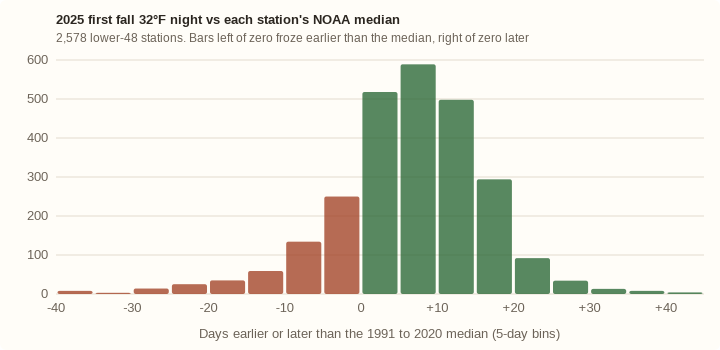
Half the stations (1,304) were at least a week later than their median. About one in five (531) were two weeks later or more. Only 244 were a week or more early. Measured against each station’s own 10% to 90% window, 77% of 2025 dates landed inside that window, 3% came before the early (10%) date, and 20% came after the late (90%) date.
When 2025’s first freeze arrived
Across those 2,578 stations, the median 2025 first freeze fell on October 24. By calendar month, 60% froze first in October, 30% in November, 6% in September, 3% in December, and under 1% in August.
The West ran latest relative to its own normals. Its median station was 11 days late, and 84% of Western stations froze later than their median. The Plains were 8 days late, the Midwest and South 7, and the East 3. Local National Weather Service climate pages show the same late tilt in places we can cross-check. The NWS Cheyenne office lists Cheyenne’s first freeze in 2025 as October 13 against an average of September 30, and Laramie’s as October 7 against September 13. Our Laramie 4 SE co-op station matches that October 7 date. The NWS Pueblo office lists Colorado Springs on October 19, 2025. Denver Water Dept, a few hours north, also hit 32°F on October 19.
A late year fits the longer trend without proving the next one. Climate Central’s city study found the first fall freeze arriving later in 179 of 204 U.S. cities since the early 1970s, by 12 days on average in those cities. Our own 75-year station analysis found the median first fall freeze 6.5 days later in 1996 to 2025 than in 1951 to 1980. 2025 sits on the late side of that shift, not outside it.
First freeze dates in 2025 for 12 metro areas
How to read the table
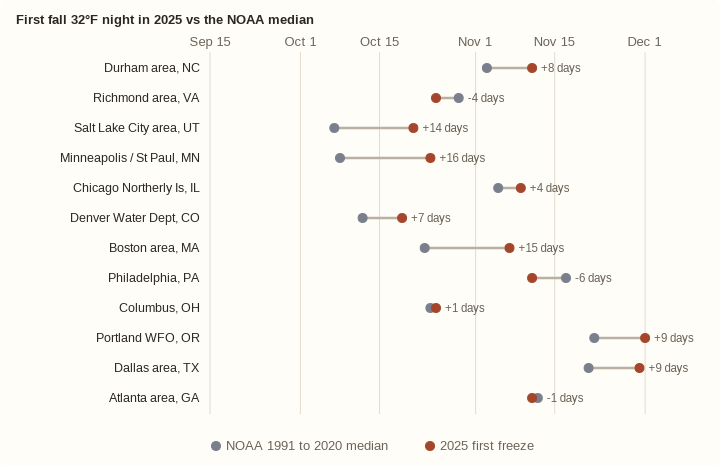
Each row is a cooperative observer station near the city, not always the airport used in the normals city table. Distance is from downtown. “2025” is the first fall 32°F night. “Median” is that station’s NOAA 1991 to 2020 median. Station names link to the year-by-year history.
| Metro area | Station (NOAA ID) | Dist. | 2025 first 32°F | NOAA median | vs median |
|---|---|---|---|---|---|
| Durham / Chapel Hill, NC | Chapel Hill 2 W (USC00311677) | 19 km | Nov 11 | Nov 3 | 8 days later |
| Richmond area, VA | Ashland (USC00440327) | 24 km | Oct 25 | Oct 29 | 4 days earlier |
| Salt Lake City area, UT | City Creek WTP (USC00421446) | 8 km | Oct 21 | Oct 7 | 14 days later |
| Minneapolis / St Paul, MN | U of MN St Paul (USC00218450) | 7 km | Oct 24 | Oct 8 | 16 days later |
| Chicago, IL | Chicago Northerly Is (USC00111550) | 3 km | Nov 9 | Nov 5 | 4 days later |
| Denver, CO | Denver Water Dept (USC00052223) | 2 km | Oct 19 | Oct 12 | 7 days later |
| Boston area, MA | Jamaica Plain (USC00193890) | 8 km | Nov 7 | Oct 23 | 15 days later |
| Philadelphia, PA | Phila Franklin Inst (USC00366886) | 1 km | Nov 11 | Nov 17 | 6 days earlier |
| Columbus, OH | Columbus Wcmh (USC00331785) | 8 km | Oct 25 | Oct 24 | 1 day later |
| Portland, OR | Portland WFO (USC00356750) | 12 km | Dec 1 | Nov 22 | 9 days later |
| Dallas area, TX | Richardson (USC00417588) | 25 km | Nov 30 | Nov 21 | 9 days later |
| Atlanta area, GA | Jonesboro (USC00094700) | 24 km | Nov 11 | Nov 12 | 1 day earlier |
Minneapolis, Boston and Salt Lake City ran two weeks late. Richmond, Atlanta and Philadelphia came in a few days early. Seattle-area co-ops disagreed with each other by weeks in 2025, so that metro is better read station by station on the history hub than as a single row.
What an early or late year means for next season
Plan with the odds, not with last fall alone
A late first freeze in 2025 gave many gardeners extra time for fall crops and delayed the cleanup of tender plants. It does not move your spring planting date by itself. The chance of another freeze after a spring date still comes from the full normals record, not from one fall. Use the ZIP lookup and the frost odds article for that call.
If you are still protecting late crops in early November, use the fall planting countdown for crops that can still finish before a hard freeze, and keep a cover ready for clear nights.
Compare last year to your own record
On a station history page you can see whether 2025 was an outlier or just another late year in a late decade. Places that have been trending later for decades will often show several recent falls past the old median. Places with a noisy record will show early and late years mixed together. Read the trend line as a slow shift, and the yearly dots as the scatter you still have to plan around.
FAQ
When was the first freeze last year in the U.S.?
There is no single national date. At 2,578 lower-48 stations with a usable 2025 record, the median first 32°F night fell on October 24, and at the typical station that night was 7 days later than the NOAA 1991 to 2020 median.
When was the first frost last year in my city?
Open your station under frost history, or start from the ZIP lookup and follow the station link. The 2025 row is the first fall date with a low of 32°F or colder. The twelve metro rows above cover Durham, Richmond, Salt Lake City, Minneapolis, Chicago, Denver, Boston, Philadelphia, Columbus, Portland, Dallas and Atlanta area stations.
Was 2025’s first freeze early or late?
Later at most stations. It ran later than the median at 76% of the stations in this study, earlier at 21%, and on the median day at 3%. About 20% froze after their usual 90% date.
What counts as the first freeze?
On this site, the first fall freeze is the first day from August 1 to December 31 with a daily minimum of 32°F (0°C) or lower, from NOAA GHCN-Daily. A hard freeze uses the same rule at 28°F. National Weather Service forecasts sometimes say “frost” for lighter cold and “freeze” for 32°F, but the station records here are temperature thresholds, not frost-on-the-ground observations.
Why does my airport’s 2025 date look missing?
In the history files we ship today, most airport (USW) stations still end with 2024. Many cooperative observer stations near the same cities already include 2025. Use a nearby co-op history page, or check your local NWS climate office, which often posts “last year’s first freeze” for the official airport site.
Does a late first freeze mean I can plant earlier next spring?
No. Spring planting should follow the chance of another freeze after your target date, from the normals and the odds tools, not from one late fall. A 7-day late year is small next to the month-wide spread between early and late first frosts at the same station.
Sources
- NOAA NCEI, Global Historical Climatology Network Daily (station daily minimum temperatures)
- NOAA NCEI, U.S. Climate Normals 1991 to 2020 (first-frost probability dates)
- National Weather Service Cheyenne, Fall First Freeze Statistics (2025 dates for Cheyenne, Laramie and nearby sites)
- National Weather Service Pueblo, Fall Freeze Data (2025 dates for Colorado Springs and Alamosa)
- Climate Central, Later First Freeze in 179 U.S. Cities (1970 to 2024 city trend)