Frost Cloth vs Waiting: A Risk Table for Tender Plants
Your seed packets and garden apps push a single “last frost date.” Plant after it and you’re fine. Plant a week or two early under frost cloth and you get a jump on the season. Both sides leave out the odds.
That single date is usually NOAA’s median: one spring in two still has a 32°F night after it. Frost cloth does help, but only by a few degrees. University of Maryland Extension rates lightweight row cover at 2°F of frost protection, medium-weight at 4 to 6°F, and heavyweight at up to 8°F. That is enough for a light frost. It is not enough for a hard freeze.
This article puts those two facts together. First, a risk table: the chance of another freeze if you plant on the median last-frost date versus 7 or 14 days earlier, at eight U.S. stations. Then what cloth actually buys you in spring, and how the same covers help on late fall nights when tender crops are still in the ground.
TL;DR:
- Planting on your “last frost date” still leaves about a 50% chance of another 32°F night. At Denver Water Dept that date is April 30. Plant 7 days earlier and the odds jump to about 70%. Plant 14 days earlier and they reach about 88%.
- UMD rates row cover at 2°F (lightweight), 4 to 6°F (medium), and up to 8°F (heavyweight). Cloth shifts the temperature under the fabric. It does not rewrite the outdoor climate odds.
- In late October, places like Denver and Minneapolis are often past their median first freeze already. Farther south and on the coasts, you still have nights left for late crops under cover.
- Harden transplants for 1 to 2 weeks before they stay out. UMD says not to put tender seedlings outdoors below 45°F.
Cover or wait: the real trade-off
What the median last-frost date actually means
Most charts’ “last frost date” is NOAA’s 50% spring date from the 1991 to 2020 Climate Normals. Plant on that date and, over the long run, half of springs still bring at least one more night at 32°F or colder. The frost odds after any date article walks through the full 10% to 90% spread. The National Weather Service calls 32°F a freeze. A hard freeze is 28°F or lower for an extended period, “killing most types of vegetation.”
Tender crops (tomatoes, peppers, beans, squash, cucumbers) cannot take a freeze. Colorado State University Extension puts tomato transplant needs at above 52°F at night and above 60°F during the day, and notes they are “readily killed by a light frost.” So the decision is not only “will it freeze?” It is also “how cold, and do I have cover ready?”
Two seasons, one decision
In spring you choose between waiting for safer odds and planting early with cloth on standby. In fall you choose whether to keep covering late crops still producing after the first frosty nights. The cloth ratings are the same. The odds flip direction: spring asks how likely another freeze is after your planting date, and fall asks how likely the first freeze has already come by a given night. Both use the same NOAA percentiles and the same straight-line estimate described in our methodology.
Spring risk table: plant on the median vs 1 to 2 weeks early
How to read the numbers
For each station below, the median column is the chance of another night at 32°F or 28°F after NOAA’s median last 32°F date. The next two columns move that planting date 7 and 14 days earlier. Odds between NOAA’s published 10% and 90% dates are a straight-line estimate, the same method as the frost-odds article. Values outside that range show as under 10% or over 90%. Your own ZIP may match a different station. Check the ZIP lookup or browse last frost dates by state.
| Station (NOAA ID) | Median last 32°F | Plant on median: 32°F / 28°F | 7 days earlier | 14 days earlier |
|---|---|---|---|---|
| Denver Water Dept, CO (USC00052223) | Apr 30 | 50% / 20% | 70% / 36% | 88% / 57% |
| Chicago O’Hare, IL (USW00094846) | Apr 16 | 50% / 16% | 77% / 33% | >90% / 60% |
| Atlanta Hartsfield, GA (USW00013874) | Mar 15 | 50% / 20% | 68% / 33% | 80% / 48% |
| Boston Logan, MA (USW00014739) | Apr 4 | 50% / 17% | 84% / 50% | >90% / 73% |
| Minneapolis Lower St Anthony, MN (USC00214884) | Apr 23 | 50% / 20% | 77% / 43% | >90% / 68% |
| Seattle Boeing Fld, WA (USW00024234) | Mar 13 | 50% / <10% | 66% / 16% | 81% / 30% |
| Detroit City Ap, MI (USW00014822) | Apr 21 | 50% / 12% | 75% / 30% | >90% / 53% |
| Kansas City Downtown, MO (USW00013988) | Apr 4 | 50% / 22% | 74% / 45% | 85% / 62% |
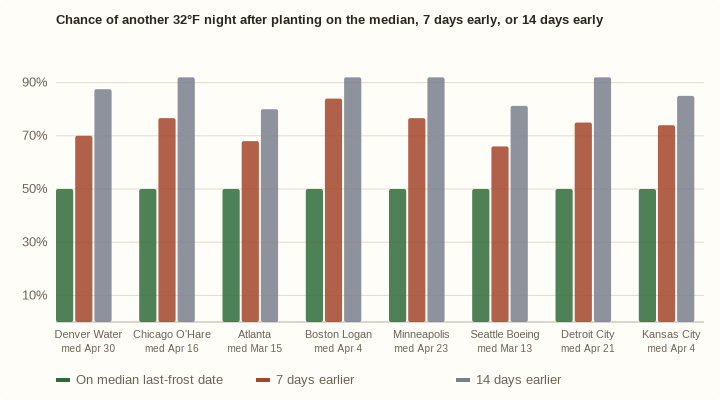
What the table says in plain English
At every station, planting on the median is a coin flip against another 32°F night. Move a week earlier and you are usually in the mid-60s to mid-80s. Move two weeks earlier and several northern and Midwestern stations cross 90%. The 28°F column matters if you care about a hard freeze that can kill even under medium cloth: at Denver, planting on April 30 still leaves about a 20% chance of a 28°F night later, and planting on April 16 raises that to about 57%.
Cloth does not change those outdoor odds. It changes the temperature around the plant on a given night. That is the next section.
How much frost cloth actually helps
UMD’s degree ratings
University of Maryland Extension’s row cover guide (updated August 25, 2026) rates spun-bonded covers by weight:
- Lightweight (about 0.45 ounce per square yard): 90% to 95% light transmittance, 2°F of frost protection. Often sold as an insect barrier.
- Medium-weight (0.5 to 1.0 ounce per square yard): 70% to 85% light, 4 to 6°F of frost protection. UMD calls this useful for spring and fall crops.
- Heavyweight (1.5 to 2.2 ounces per square yard): 30% to 50% light, up to 8°F of frost protection. Aimed at overwintering crops.
UMD also notes that temperatures under a row cover can run 5 to 15°F warmer than outside in summer heat, so you pull covers when days get hot. For medium and heavyweight fabric, UMD recommends a support frame rather than draping the cloth directly on the plants.
What those degrees buy you on a cold night
Think in outdoor forecast lows, not in “odds”:
- Forecast 30 to 32°F (light frost): lightweight cloth’s 2°F can keep tender leaves above freezing. Medium-weight gives more margin.
- Forecast 26 to 28°F (hard-freeze territory): lightweight is not enough for tomatoes. Even heavyweight’s “up to 8°F” is a stretch if the night stays cold for hours. Plan to harvest or accept losses on tender crops.
- Forecast mid-20s or colder: covers buy time for hardy greens. They do not make tomatoes safe.
University of Nebraska-Lincoln Extension lists the same quick covers for a single cold night: lightweight blankets, sheets, newspapers, buckets and floating row covers. UNL’s point is simple. On clear nights the ground loses heat fast, and a cover holds that heat around the plants. Uncover once the air is back above 32°F.
None of this turns an 88% outdoor freeze risk into a safe bet. It turns a borderline night into a survivable one when you are already close to your median date and the forecast is a light frost, not a hard freeze.
Harden off before the plants stay out
If you start transplants indoors, harden them for 1 to 2 weeks before they live outside. University of Maryland Extension says to start in a shaded, protected spot on warm days, bring plants in at night, and add sun each day. UMD’s rule of thumb: “Don’t put tender seedlings outdoors on windy days or when temperatures are below 45° F.” After proper hardening, UMD notes, “tomato plants can usually tolerate light and unexpected frosts with minimum damage.” That is tolerance of a brief light frost on a hardened plant, not a substitute for waiting out a hard freeze.
Fall nights: covering late crops still in the ground
Where October 22 sits against the first freeze
Late October is when many U.S. gardeners are either past the first freeze or watching the forecast every clear night. Using the same eight stations, here is the chance the first 32°F night (and the first 28°F night) has already come by October 22, plus each station’s median first 32°F date:
| Station | Median first 32°F | By Oct 22: 32°F | By Oct 22: 28°F |
|---|---|---|---|
| Denver Water Dept, CO | Oct 12 | 82% | 53% |
| Minneapolis Lower St Anthony, MN | Oct 16 | 70% | 33% |
| Chicago O’Hare, IL | Oct 28 | 25% | <10% |
| Detroit City Ap, MI | Oct 31 | 23% | <10% |
| Kansas City Downtown, MO | Nov 2 | 12% | <10% |
| Boston Logan, MA | Nov 9 | <10% | <10% |
| Seattle Boeing Fld, WA | Nov 17 | <10% | <10% |
| Atlanta Hartsfield, GA | Nov 20 | <10% | <10% |
In Denver and Minneapolis, October 22 is usually after the median first freeze. Covering what is left of tender crops is a salvage move, and a hard freeze is already common in Denver by then. In Chicago, Detroit and Kansas City you are in the window where a cover over late tomatoes or beans can still matter on the next clear night. In Boston, Seattle and Atlanta the median first freeze is still weeks out, so the same cloth that you use in spring is mainly for the first light frosts, not for a season that is already over. City-level fall dates for 79 places are in first frost dates by city. For sowing math on fall crops, use the fall planting countdown.
Same cloth, different goal
In fall you are not trying to establish tender transplants. You are protecting fruit already on the plant, or buying a few more nights for semi-hardy greens. UNL notes that in Nebraska the first frost is often followed by two to three weeks of warmer weather, and that covers can carry frost-tender plants through those weeks. Pull the cover once mornings are above 32°F so plants get light and air. UMD’s medium-weight rating (4 to 6°F) is the practical sweet spot for most home gardens: enough for light frost, without the heavy light loss of the thickest fabric.
FAQ
When is it safe to plant tomatoes outside?
There is no single safe date. On NOAA’s median last 32°F date, about half of springs still bring another freeze. Many gardeners wait for the 10% date (only one spring in ten has a later freeze), or they plant near the median with row cover ready for light-frost nights. CSU Extension also wants warm soil and nights (above about 55°F soil, and above 52°F at night for tomatoes), not only a frost date on the calendar.
Does frost cloth really protect plants from frost?
Yes, within a few degrees. UMD rates lightweight row cover at 2°F of frost protection, medium-weight at 4 to 6°F, and heavyweight at up to 8°F. That can save tender plants on a 30 to 32°F night. It will not reliably save them on a hard freeze at 28°F or below.
Can I plant tomatoes a week or two before the last frost date?
You can, if you accept higher odds of a freeze and keep cloth or another cover ready. At the eight stations in the table, planting 7 days before the median usually raises the chance of another 32°F night into the mid-60s to mid-80s. Planting 14 days early often pushes past 80%, and past 90% at several northern stations.
Should I cover my plants on a frosty fall night?
If tender fruit is still on the plants and the forecast is a light frost, yes. UNL lists blankets, sheets, buckets and floating row covers for exactly that job. If the forecast is a hard freeze near 28°F or lower, harvest ripe and nearly ripe fruit instead of trusting lightweight cloth.
How do I harden off tomato seedlings?
UMD’s method: start 1 to 2 weeks before transplanting, put plants outside in shade on warm days, bring them in at night, and add sun each day. Do not put tender seedlings out below 45°F or on very windy days. Reduce watering a little so growth firms up, but do not let plants wilt.
Will a bed sheet protect plants as well as frost cloth?
A sheet or blanket can work for one cold night the way UNL describes, by trapping ground heat. Purpose-made row cover lets more light and rain through, so it can stay on for days. UMD’s degree ratings apply to commercial spun-bonded row cover weights, not to household sheets.
Sources
- NOAA NCEI, U.S. Climate Normals 1991 to 2020, frost/freeze dates (spring last and fall first at 28°F, 32°F and 36°F). Odds between published percentiles are our straight-line estimate. See methodology.
- University of Maryland Extension, Row Covers / Vegetable Garden Weather and Pest Protection (updated Aug 25, 2026). https://extension.umd.edu/resource/row-covers
- University of Maryland Extension, Hardening Off Vegetable Seedlings for the Home Garden (updated Feb 20, 2023). https://extension.umd.edu/resource/hardening-vegetable-seedlings-home-garden
- University of Nebraska-Lincoln Extension, Fall Vegetable Gardening, NebGuide G1343 (Lott and Lindgren). https://extensionpubs.unl.edu/publication/g1343/na/html/view
- Colorado State University Extension, Growing Tomatoes. https://extension.colostate.edu/resource/growing-tomatoes/
- National Weather Service glossary, Freeze / Hard Freeze. https://forecast.weather.gov/glossary.php?word=freeze